
Quality Begins At Day One!
Engineering Support
Before the tool design is finalized, our engineers collaborate with your team to review the part design for potential material savings, cycle time reductions, and quality enhancements.
We adhere to and implement the Society of the Plastics Industry (SPI) guidelines and standards for Mold Classes, Mold Finish, Cosmetic Inspection, and Dimensional Tolerances.
Additionally, we offer options and recommendations for selecting tool-builders to quote your project. Guttenberg Industries is privileged to work with several local and regional tool shops renowned for their quality molds. In addition, for the past decade, we have provided our customers with the option to utilize our carefully selected offshore partners for injection mold construction. Ultimately, it will be our customers’ decision on which source they’d like to use.

Product Development Lead Time
In today's competitive landscape, time to market is crucial. The faster you can introduce your product to the market, the sooner you can start generating returns on your investments. At Guttenberg Industries, we recognize this imperative and consistently strive to help you reduce this timeframe. We employ rapid prototyping services where applicable and offer quick turnaround tooling upon request. Please inform us if you are interested in exploring these options.
Design Tolerances
Tolerance guidelines are expressed as a base (minimum) tolerance plus added tolerance based on the linear inch of a given product feature; they represent typical variation from part to part once molded. As an example, a two-inch feature on a product molded from ABS will likely consume a tolerance of ±.005 inches, while the same feature on a part molded from Polypropylene might consume a tolerance of ±.007 inches.
Design for Manufacturability (DFM)
Design for Manufacturability, or DFM, is a time-tested tool to help product designers minimize costs and time to market. Complex designs incur additional costs. While complexity is sometimes necessary, unnecessarily complex plastic injection molding designs can increase manufacturing costs significantly. Our professional staff at Guttenberg Industries aims to help you use DFM principles to keep your designs as simple as possible while keeping costs to a minimum.
Material Selection
Designing injection-molded plastic parts can be complex and confusing. While designing for any material is already a challenge, the complexity of injection-molded plastic is compounded further by the unique nature of polymers and the molding process. Guttenberg Industries has built a solid reputation within the injection molding industry for our ability to conquer the toughest jobs in plastic.
In many instances, the first decision that needs to be made is which material to use. Thanks to technology, there are literally hundreds of materials and blends that may work for your project. However, when designing a plastic part, material selection is critical. There are many factors to consider when choosing a material, such as strength, hardness, impact resistance, heat resistance, chemical resistance, and cost.
Project Costs
Consider the Total Cost of Ownership, Not Just Price.
When designing injection-molded plastic products, there are two types of costs to consider. The first is the piece-part cost, which is the amount paid to the injection molder for each individual part produced. The second is the tooling cost.
Unfortunately, not all customers fully consider the trade-off between these two when finalizing their purchase decisions. In many cases, a customer focuses too heavily on piece price and ends up investing in a more expensive tool than necessary, driving up the total project cost. Conversely, a customer may choose an inexpensive, single-cavity tool to save money upfront, only to incur higher long-term costs due to decreased production efficiency.
Part Design Suggestions
Our review of part design begins during the quoting stage. Our experienced estimating team is skilled in detecting product features that add cost and risk downstream quality problems. If we believe we can save you money, suggestions are often provided during this phase.
Otherwise, a more detailed analysis is performed by a team of experts during the early stages of the product launch. This team actively searches for cost-saving opportunities and design features that might create risks later in the process. Moldflow simulation software is used to detect potential issues, maximizing the potential for first-round success. Any ideas are communicated to you immediately so that you may update the design quickly if you choose to do so. If you decide not to act on our suggestions, we will continue to support your project in any way we can.
We now even provide free online assistance with an 11-page PDF that highlights 10 design tips for injection-molded parts and products, as well as insights on plastic materials and tolerances.
Mold Design Suggestions
Guttenberg Industries offers customers the option of domestic or offshore tool builds, with complete oversight and production of parts manufactured in our Iowa facility.
Tool designs are developed by toolmakers based on the CAD models provided by Guttenberg Industries on behalf of you, the customer. Before any actual tool work is begun, the tool design must be approved by Guttenberg Industries. Improper tool design can lead to quality problems, increased production costs, and limited tool life. To minimize the risk, our team of experts reviews each tool design with a point checklist, ensuring the highest quality tool for your money.
We coordinate the tool build and offer weekly progress updates upon request. We work with your engineers and quality professionals to ensure we understand your unique quality requirements before the mold is even complete. When the mold is complete, we sample the mold to verify it meets your requirements and tweak the mold or process until it does.
And, if you are transferring a tool from another molder, we still do all of the same, except for the tool build.
How Does Guttenberg Industries Ensure Quality Products?
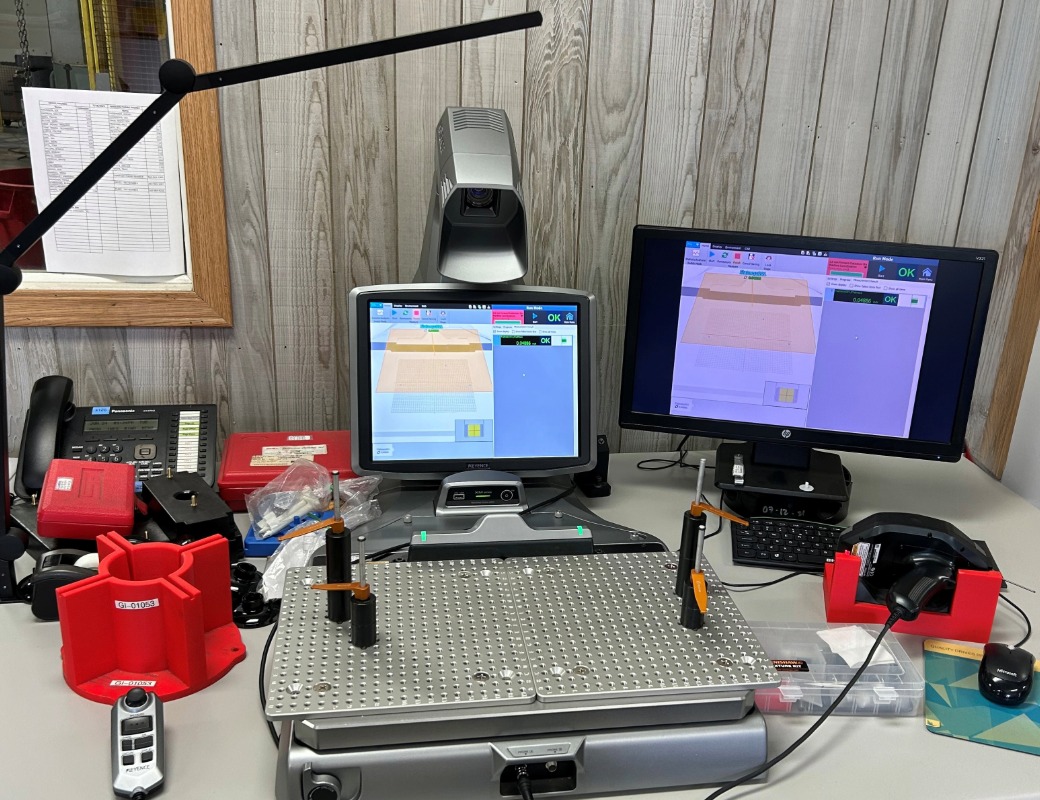
Keyence XM Series
This hand-held Coordinate Measuring Machine (CMM) offers versatile measurements from points inaccessible to traditional Bridge CMMs and vision-guided machines. It provides highly accurate measurements within ±3 microns. The measurement area is 23.62″ wide by 14.96″ tall, accommodating large parts. The XM Series uses advanced algorithms to ensure precision and is user-friendly, requiring minimal training.
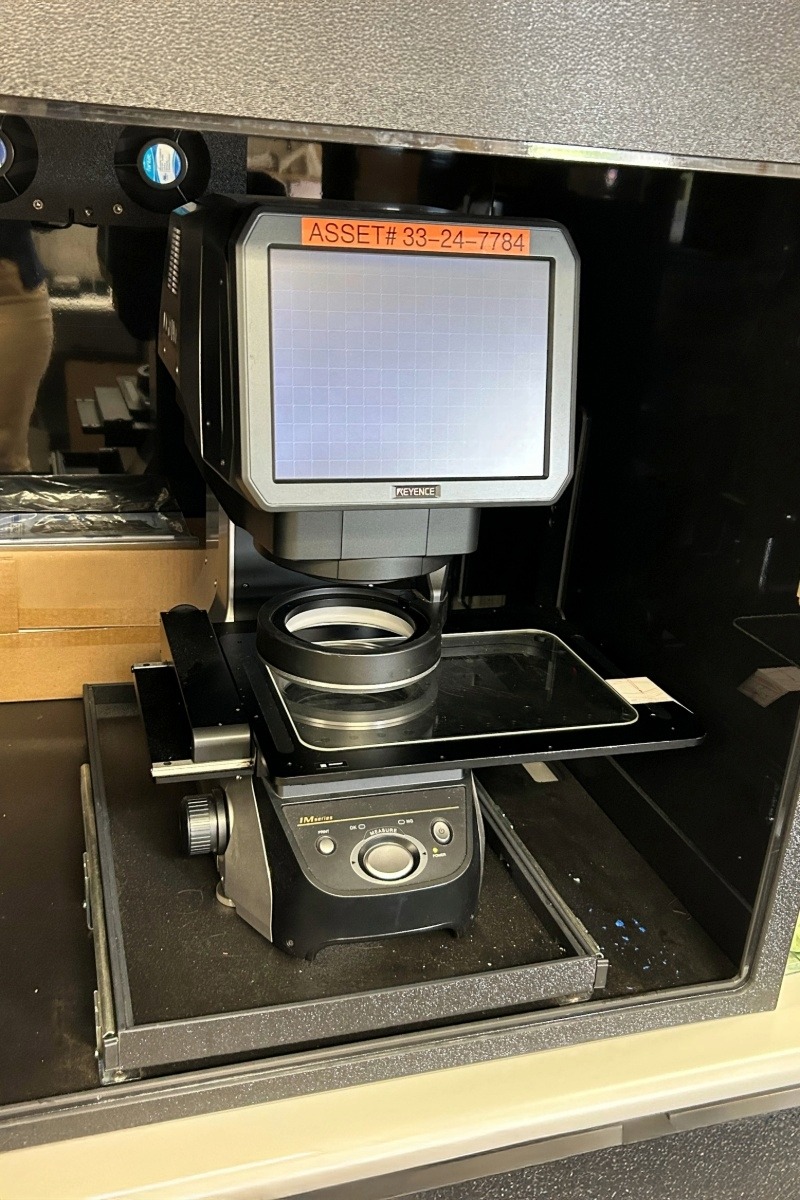
Keyence IM Series
An optical comparator capable of measuring multiple dimensions across several parts simultaneously. It features a high-resolution camera and a light probe for touch measurements, both with 2-micron accuracy. The IM Series is designed for quick, consistent measurements with a simple push-button operation once programmed. It integrates advanced image processing technology to enhance measurement reliability.
Our inspection equipment includes additional video inspection machines, a wide range of classic handheld instruments, and numerous checking fixtures. Every member of our quality assurance staff is also a hands-on expert in production, ensuring that all measurements and inspections meet stringent quality standards.
Molding Instructions & Requirements
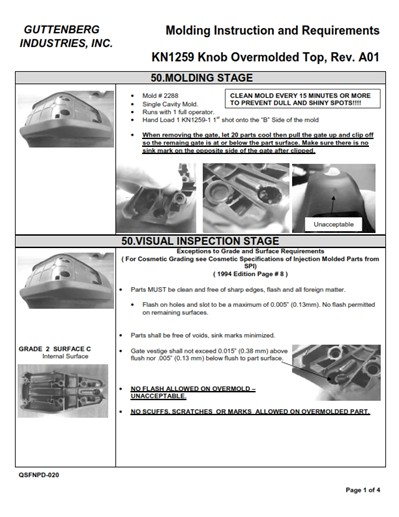
Our team is here to ensure quality at every step of our process. Getting started is simple! We will follow your Molding Instruction Requirements (MIR): digital photographs, visual and dimensional acceptance criteria, and product-specific key characteristics and concerns. We encourage customers to specify the functional and cosmetic characteristics of each part.
Our quality assurance team operates 24/5, conducting routine cosmetic and dimensional inspections. We can measure any measurable attribute, with most instruments featuring data ports for easy data collection and analysis.
We utilize Statistical Process Control software to monitor and detect out-of-specification conditions before they become out-of-tolerance.
Your quality requirements are communicated clearly and diligently throughout our organization, integral to our ISO certification and our commitment to superior customer satisfaction with high-quality parts.
Discover how we can integrate quality into your process.